Let's be completely honest: the classic Solitaire formula, while timeless, can sometimes feel a bit stale. We've all spent countless hours stacking alternating red and black cards. But what happens when you take the traditional 52-card deck, strip away the tedious stacking mechanics, and inject the high-stakes combinations of Texas Hold'em into a hyper-casual "match and clear" puzzle engine? You get Super Poker.
On the surface, Super Poker presents itself as an easy-going time killer. You see a grid of face-up cards, you tap the ones that make a poker hand, and they vanish. Simple, right? Wrong. Beneath this casual exterior lies a surprisingly deep strategic layer. Every time you eliminate cards, new ones drop down to take their place. If you blindly tap pairs without considering the broader board state, you will inevitably hit a deadlock where no valid hands can be played, bringing your run to a frustrating end. In this massive, 1,000+ word deep-dive strategy guide, we are going to dissect the mathematical rules of Super Poker, analyze every valid elimination hand, and teach you how to maximize your score while surviving the brutal endgame.
Phase 1: The Anatomy of the Board
When you boot up a fresh round of Super Poker, you are greeted with a fully populated grid of playing cards.
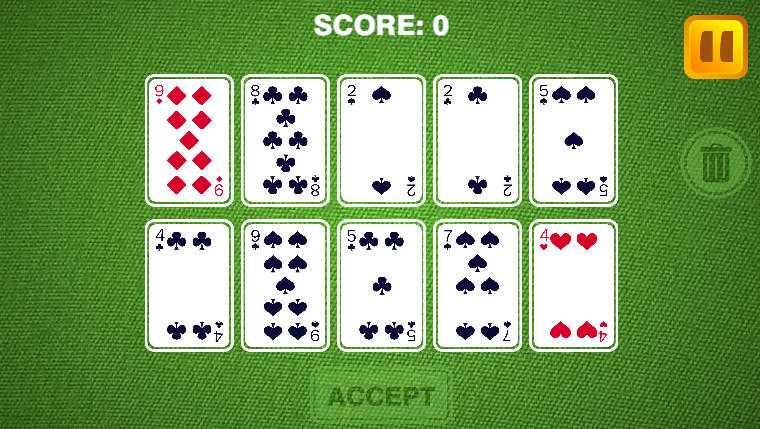
The core gameplay loop revolves around identifying valid poker hands scattered anywhere across the board. They do not need to be adjacent to one another. Once you select a valid combination, those cards are instantly destroyed. The catch? Gravity takes over. New cards fall from the top of the screen to fill the void. This "cascading replacement" system means the board state is constantly evolving. Your primary goal is to keep clearing cards until the deck runs dry and the board is completely empty. The game ends either in a glorious full clear, or in a "Game Over" state when no legal moves remain.
Phase 2: The Arsenal of Eliminations
To survive and climb the leaderboards, you must memorize the 8 valid elimination rules. Relying solely on one type of hand is a guaranteed path to failure. Let's break down your arsenal, from the simplest clears to the most complex board-sweepers.
1. The Humble Pair
The most basic move in the game. Selecting any two cards of the identical rank (e.g., two 9s or two Aces) will eliminate them. While easy to spot, relying too heavily on pairs is a rookie mistake. It burns through board real estate slowly and doesn't score well. Use pairs to unclog the board, not as your primary weapon.
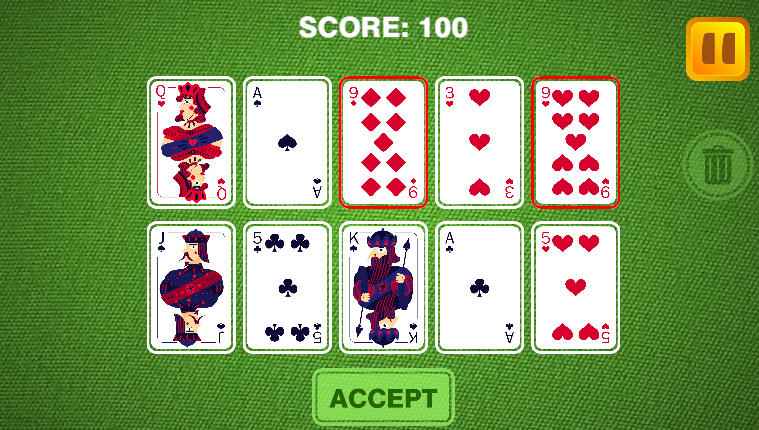
2. Two Pairs (The Double Tap)
A step up in efficiency. You can select two distinct pairs at the same time (e.g., two 10s and two Queens). This allows you to clear 4 cards simultaneously, triggering a larger cascade of replacement cards and giving you more fresh options to work with.
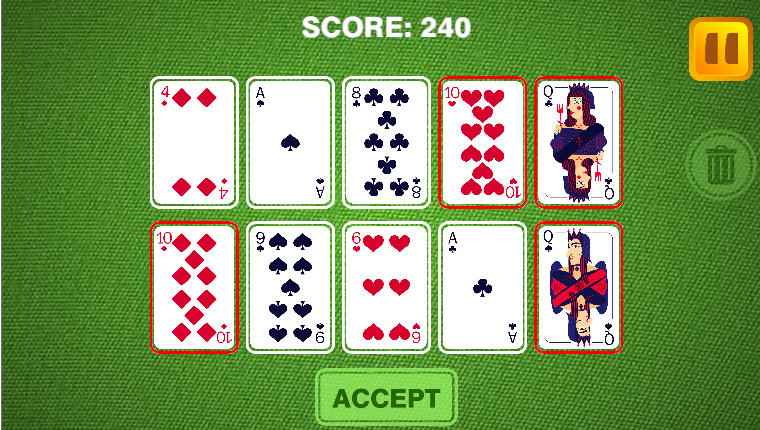
3. Three of a Kind (Trips)
Finding three cards of the same rank (e.g., three 4s). This is your bread and butter mid-game clear. It is highly efficient and helps remove awkward odd-numbered clusters that can lead to deadlocks later.
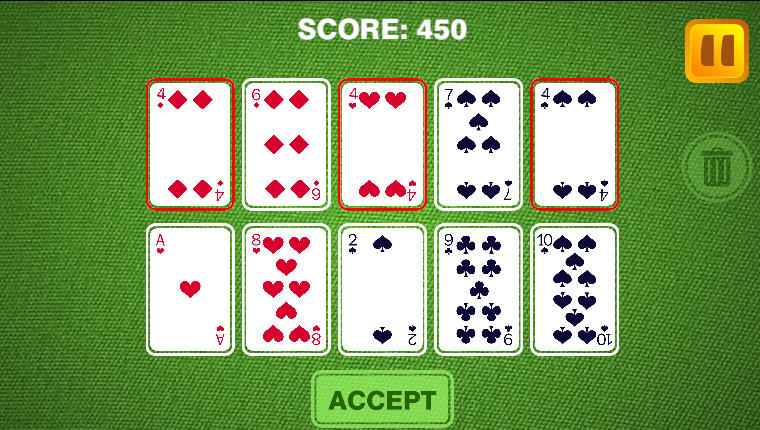
4. Full House (Three of a Kind + A Pair)
This is where the strategy really opens up. If you have a set of three (e.g., three 3s) and a pair (e.g., two 2s), you can combine them into a Full House. Clearing 5 cards at once causes a massive board shift. If you have a pair of 2s blocking a crucial column, piggybacking them onto your three 3s is a brilliant tactical maneuver.
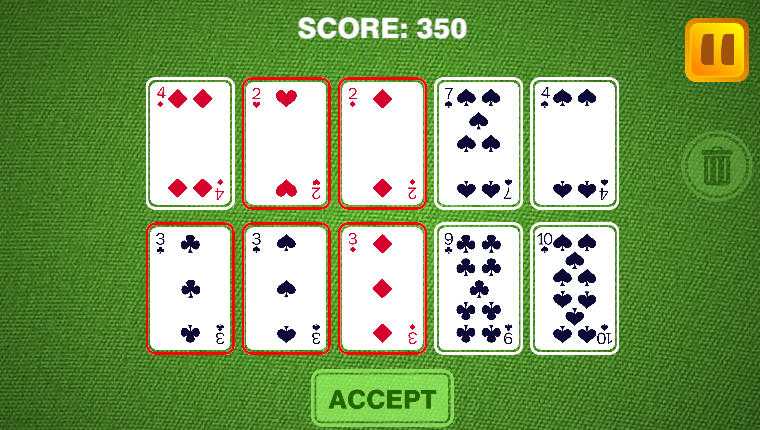
5. Four of a Kind (Quads)
A rare but immensely satisfying clear. Selecting four identical cards (e.g., four Kings) wipes them off the board instantly. If you see three Kings, it is often worth waiting for the fourth one to drop before clearing them, maximizing your score multiplier.
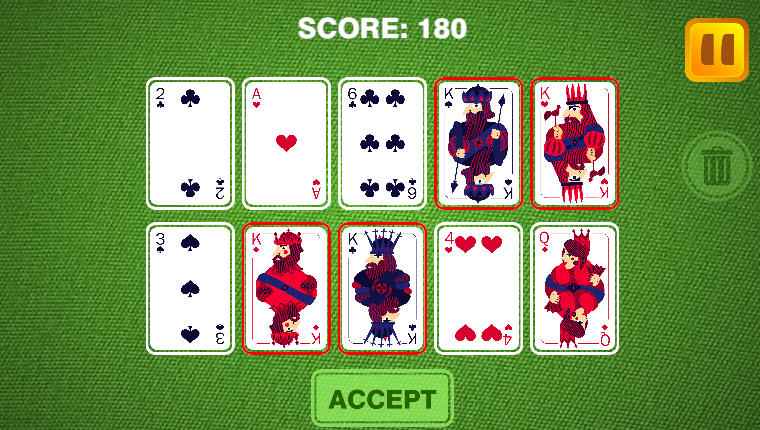
6. Four of a Kind + A Single (The Kicker)
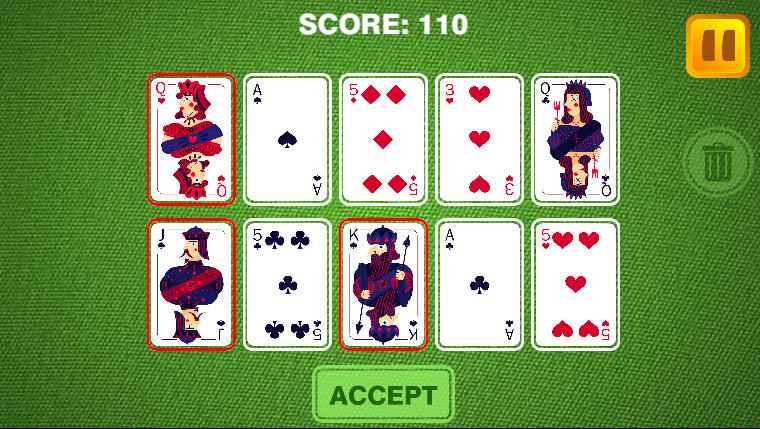
This is a mechanic unique to Super Poker and is an absolute lifesaver. You can clear Quads along with any random single card (e.g., four 5s and one pesky 3). Why is this important? Because that single 3 might be a "junk card"—the last of its kind on the board with no other pairs left to match it with. The "Kicker" rule allows you to execute junk cards that would otherwise cause a Game Over.
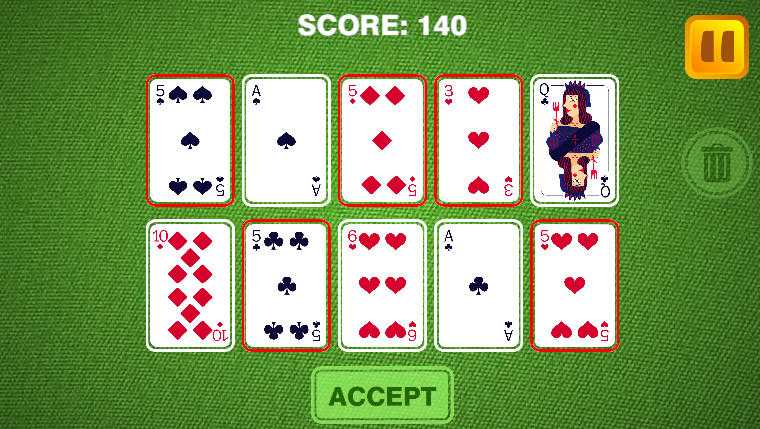
7. The Short Straight (3 Consecutive Cards)
A sequence of three cards in ascending order, regardless of suit (e.g., Jack, Queen, King). Straights are incredibly valuable because they allow you to clear cards of different ranks, preventing your board from becoming saturated with unmatchable singles.
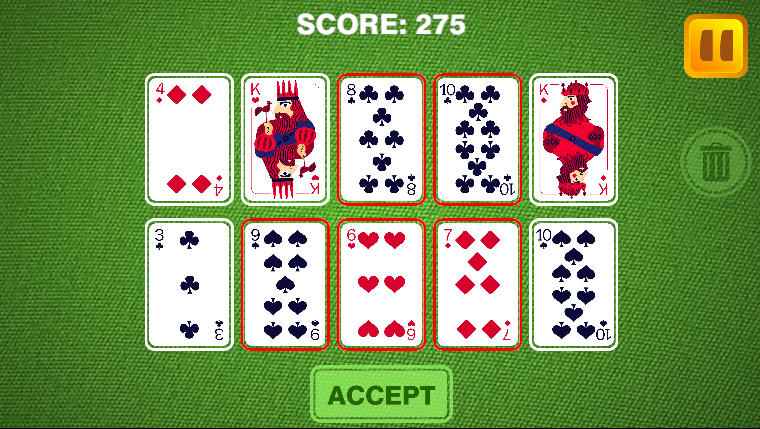
8. The Long Straight (5 Consecutive Cards)
The pinnacle of board clearing. A five-card sequence (e.g., 6, 7, 8, 9, 10). Executing this move requires acute observation and a bit of luck with the cascading drops, but it yields the highest score and clears nearly a quarter of the board in one satisfying swoop.
What happens when you are staring at a board with one lone 7, and absolutely no other 7s or sequential cards to match it with? You use the Trash Can. You can literally drag any single card into the bin to instantly delete it. However, you only get TWO chances per game. Do not burn your Trash Can charges in the early game! Save them strictly for the final 10 cards when a single unmatched card threatens to end your entire run.
Gameplay Walkthrough: The Flow State
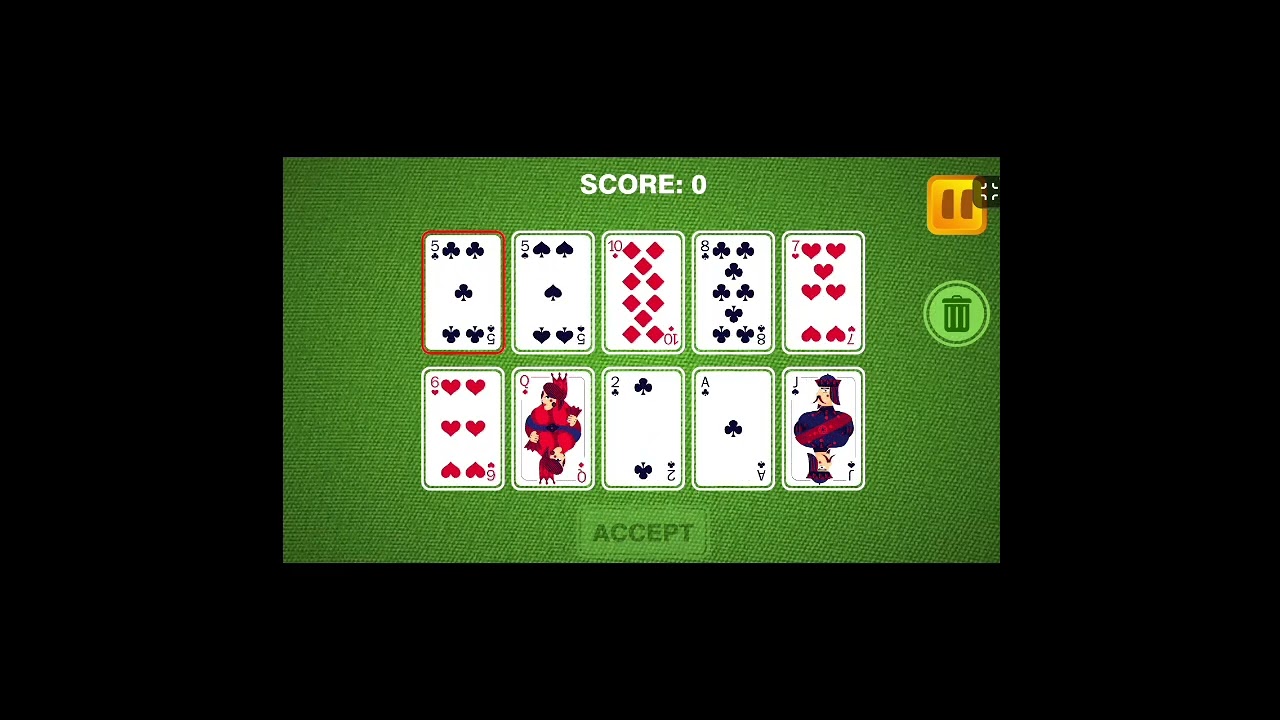
To truly understand how to pivot between pairs, full houses, and straights, you need to see the game in motion. Watch the gameplay footage below. Notice how the player constantly scans the board before making a move, prioritizing larger 5-card clears to force massive cascades, and keeping the board balanced rather than just aggressively tapping pairs.
Phase 3: Elite Strategies for the Endgame
If you want to achieve a full board clear and secure a high score, you need to shift your mindset from "finding matches" to "managing the deck." Here are three elite strategies to implement:
1. The Junk Card Assessment: Periodically stop and scan the board for "singletons"—cards that have no matching pair and do not fit into any visible straights. Your immediate goal should be to manipulate the board state to either bring down a match for that singleton, or prep a Four of a Kind so you can use the singleton as a Kicker to destroy it.
2. Vertical Column Management: Cards only drop straight down. If you focus all your clearing efforts on the left side of the board, the right side will stagnate, trapping potential matches beneath layers of dead cards. Try to clear cards evenly across all columns to ensure a steady rotation of fresh cards across the entire grid.
3. Hold the Quads: If you see four 8s on the board, do not instantly tap them! Wait. Four of a Kind is your ultimate "get out of jail free" card because it allows you to attach a junk card. Keep those four 8s on the board as a loaded weapon until a dangerous, unmatchable card appears, then use the Quads to execute it.
Final Verdict: Deal Me In
Super Poker brilliantly bridges the gap between the relaxing nature of classic Solitaire and the rapid pattern-recognition demands of a match-3 puzzle. By internalizing the various poker hands, resisting the urge to burn your Trash Can charges prematurely, and weaponizing Quads to eliminate junk cards, you will transform from a casual clicker into a true card sharp. The deck is shuffled, the grid is set—it's time to play your hand!