Tangled Climber Escape Strategy Guide: Master Rope Physics & Anchor Routing
High-altitude emergency response scenarios require split-second analytical thinking, but when you introduce complex rope geometry and extreme spatial restrictions into the mix, you get an incredibly engaging brain-teasing experience. Tangled Climber Escape takes the foundational mechanics of classic cable-untangling logic puzzles and builds an immersive thematic experience around a group of mountaineers stranded on a vertical cliffside. Instead of sorting out regular electrical wires, players manage the structural integrity of high-tension safety lines that have twisted into massive, multi-layered knots. It offers an excellent combination of spatial visualization, priority routing, and time management that pushes your logical deductions to their absolute limits.
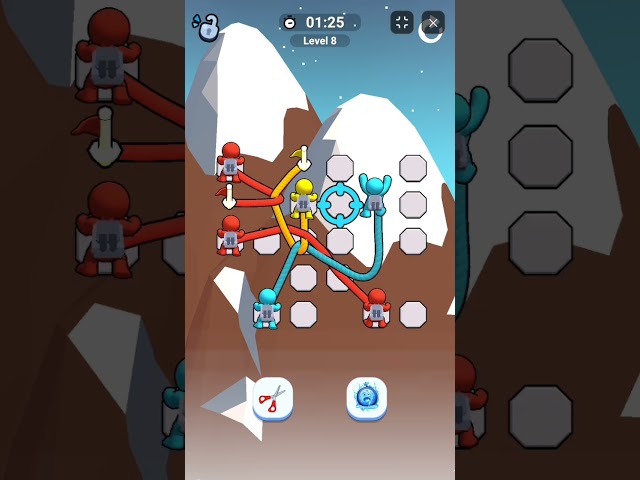
The layout mechanics are elegant yet deceptively difficult to solve. Your ultimate goal is to move stranded climbers from their current rock anchors to vacant pegs scattered across the cliff face until no safety lines overlap. When safety lines cross, they glow with an intense high-tension color scheme, showing that the climbers are locked down and vulnerable. Shifting your climbers systematically until every line turns clear and tension-free signals a successful rescue operation. As you progress higher up the mountain peaks, the puzzles scale up drastically—introducing more climbers, narrower rock shelves, and overlapping rope configurations that block easy routes. Beating these high-tier stages requires an analytical eye to spot the root of the knot before your countdown timer hits absolute zero.
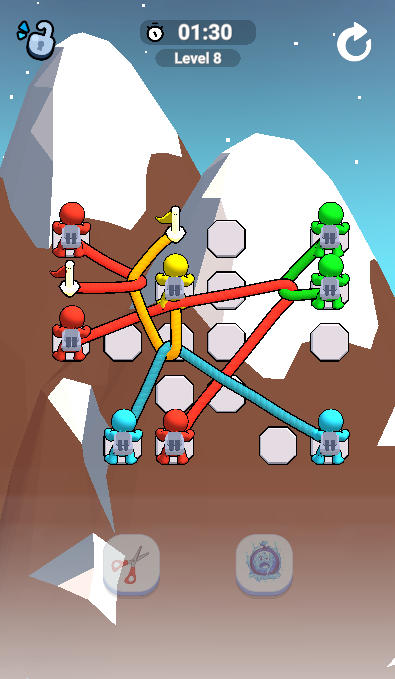
Decoding the Topology of Rope Intersections
To establish a consistent winning streak in Tangled Climber Escape, you must train your eyes to look past the character models and focus entirely on the spatial lines connecting them. Each climber acts as a dynamic node, while their colored safety lines represent paths stretched between rigid anchor points. A climber can only be shifted if there is an open, unoccupied rock peg within their rope's immediate radius. Dragging a climber to an adjacent open peg completely alters the physical layout of their line, reshaping its spatial relationship with every other line on the screen.
The primary trap that catches beginners off guard is making erratic, uncalculated movements. Shifting a climber into a vacant spot without studying the underlying lines can wrap their rope around three separate strands, compounding the initial bottleneck. Experienced puzzle solvers use a method called "layer stripping." Before moving anything, find the outermost rope—the strand that sits on top of the knot pile and has the lowest number of cross-points. Routing these superficial lines toward the external boundaries of the anchor matrix loosens up the core clutter, giving you the necessary breathing room to solve the deeper knots.
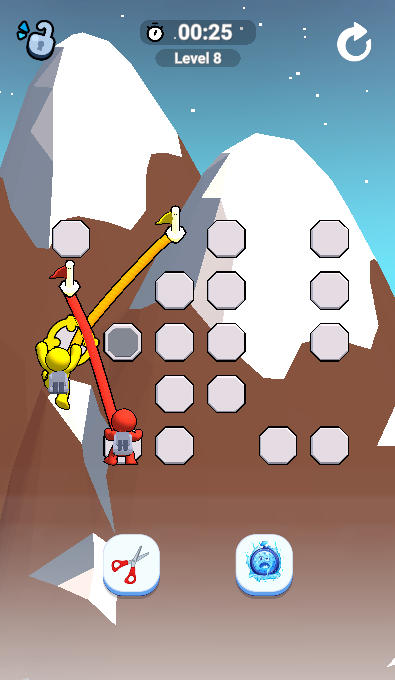
Navigating Severe Spatial Bottlenecks
As you scale the intermediate and advanced zones of the mountain, the open parameters of the grid shrink noticeably. While early levels give you plenty of spare anchor pegs to temporarily park climbers, late-game stages crowd multiple mountaineers onto narrow ledges with only one or two empty anchors available across the entire cliff face.
This extreme restriction turns the puzzle into a high-stakes sliding-block matrix. To shift a deeply buried central line, you often have to orchestrate an intricate multi-step rotation—moving three completely unentangled climbers out of their ideal positions just to create a temporary path for the target node, and then reversing the entire sequence to restore order. This requires careful forward planning; a single blind placement can cause a massive gridlock, forcing you to waste precious seconds manually retracing your steps.
Surgical Use of the Tactical Power-Up Kit
When the level layout feels mathematically locked and the countdown timer enters the danger zone, the game provides two highly valuable tool systems. Knowing when to deploy these assets is critical for saving a near-failed run.
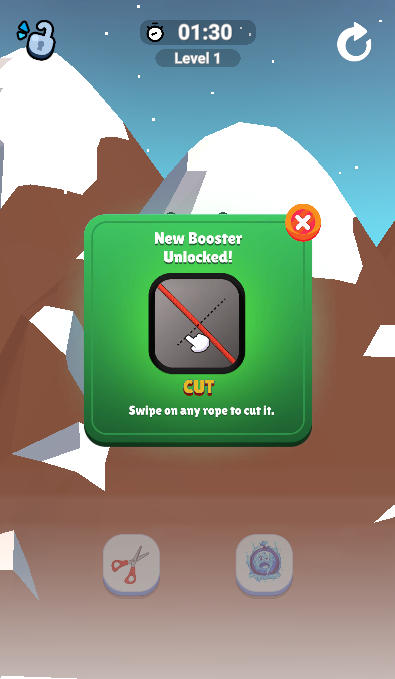
The Scissors Tool: Executing Strategic Cut-Lines
The Scissors power-up serves as your direct emergency option. Activating the item and sliding your finger cleanly across a targeted safety line severs the rope instantly, removing it from the active puzzle board. This immediate reduction in line density clears out space, liberating any neighboring ropes that were trapped beneath it.
To maximize the efficiency of this limited tool, avoid wasting it on minor lines that can easily be untangled manually. Instead, save your Scissors for the ultimate bottleneck line—the longest, high-degree intersection rope that runs directly through the center of the knot and crosses multiple paths. Cutting this primary line triggers an instant drop in tension across the board, allowing you to untangle the remaining short strands without needing complex anchor swaps.
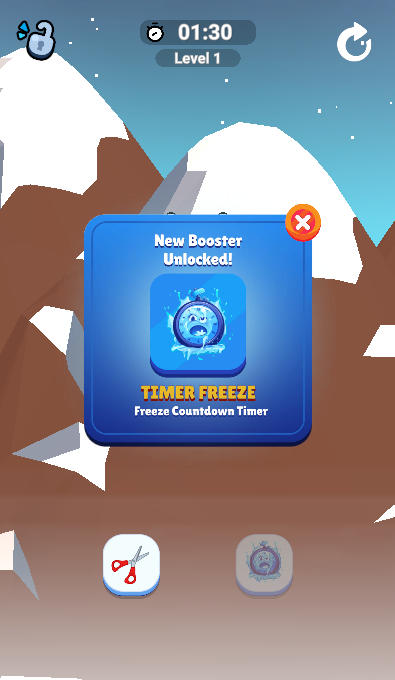
The Freeze Mechanism: Manipulating the Tactical Loop
Time limits are the true hidden threat in Tangled Climber Escape. The pressure of the fast-ticking clock often triggers rushed decisions, causing players to swipe wildly and create even tighter, accidental knots. The Freeze power-up counteracts this by halting the countdown timer completely for a generous duration while keeping the puzzle fully responsive.
The ideal time to activate the Freeze mechanic is right after executing a major position swap that leaves you with a completely new arrangement of knots. Halting the clock gives you the perfect opportunity to calm down, study the fresh configuration without stress, trace the new rope pathways, and calculate your next five moves safely. It transforms a chaotic scramble back into a calculated exercise in pure logic.
Video Walkthrough: Real-Time Routing Efficiency
To see these routing methodologies and power-up mechanics used in live gameplay, study the short video walkthrough provided below. Pay close attention to how the player avoids frantic movements, opting instead to identify the main tension anchors and systematically clear the perimeter paths first to ensure a smooth, error-free run.
Pro Tips for High-Tier Alpine Domination
Implementing these advanced mental habits will help you maintain a flawless clear record as you push deep into the brutal stages past level 25:
- Map Out Vacant Anchor Paths: Treat empty rock pegs like the open spaces on a chessboard. Before moving your first climber, identify every empty anchor and plan out how to swap positions to keep those spaces fluid.
- Clear from Exterior to Interior: Always resolve the superficial, outermost rope layers first. Clearing the exterior lines gives you a cleaner look at the internal core knot and prevents you from making messy, unnecessary crosses.
- Anticipate the Tension Vector: Whenever you shift a climber, look at both ends of their rope. Freeing a line on the left might pull it tight across an anchor on the right, creating a new problem. Always check the full path before releasing your finger.
- Hoard Your Daily Power-Up Rewards: Make it a habit to log in daily to claim your bonus chests. Stockpiling a healthy reserve of Scissors and Freeze items ensures you have the necessary tactical options ready when you hit the massive difficulty spikes in later chapters.
With an analytical approach, calm spatial planning, and smart management of your tactical items, no cliffside tangle is too complex to clear. Study the lines, track your anchors, and guide your team of climbers safely down the mountain peak!
If you encounter any specific operational issues or want to provide targeted feedback regarding level balance and layout designs, please reach out to our dedicated support team at support@puzzlechallengehub.com. We closely review player insights to continuously optimize our strategy maps.
Play Tangled Climber Escape Online

Tangled Climber Escape
Test your spatial problem-solving skills on a vertical cliff face! Shift stranded climbers between anchor points, use powerful tools like scissors and freeze items, clear the intersecting safety ropes, and beat the ticking countdown clock.