Tap Out: Block Escape Strategy Guide: Master 3D Spatial Rotation, Arrow Trajectory & Clearance Order
Spatial puzzle games have experienced a remarkable evolution, transitioning from traditional 2D flat grid sorting to immersive, full-3D disassembling experiences. Among the standout entries in this modern puzzle standard, Tap Out: Block Escape offers an exceptionally clean, soothing, yet deeply intellectual challenge. Built around a deceptively straightforward objective—clearing a complex cluster of 3D cubic blocks from the screen—the game transforms basic directional mechanics into an engaging test of 3D visualization and sequence planning.
At first glance, tapping a block to make it slide away feels instantly satisfying. However, as block configurations grow denser and feature complex interlocking layers, simple trial-and-error quickly gives way to strategic analysis. Every single block on the grid is constrained by a fixed movement vector indicated by an arrow on its surface. If another block sits directly in its escape path, tapping it yields only a metallic nudge—a firm reminder that you must solve the outer structural lock before reaching the inner core. This comprehensive guide covers everything from camera rotation techniques to high-level trajectory analysis, helping you clear every stage with maximum efficiency.
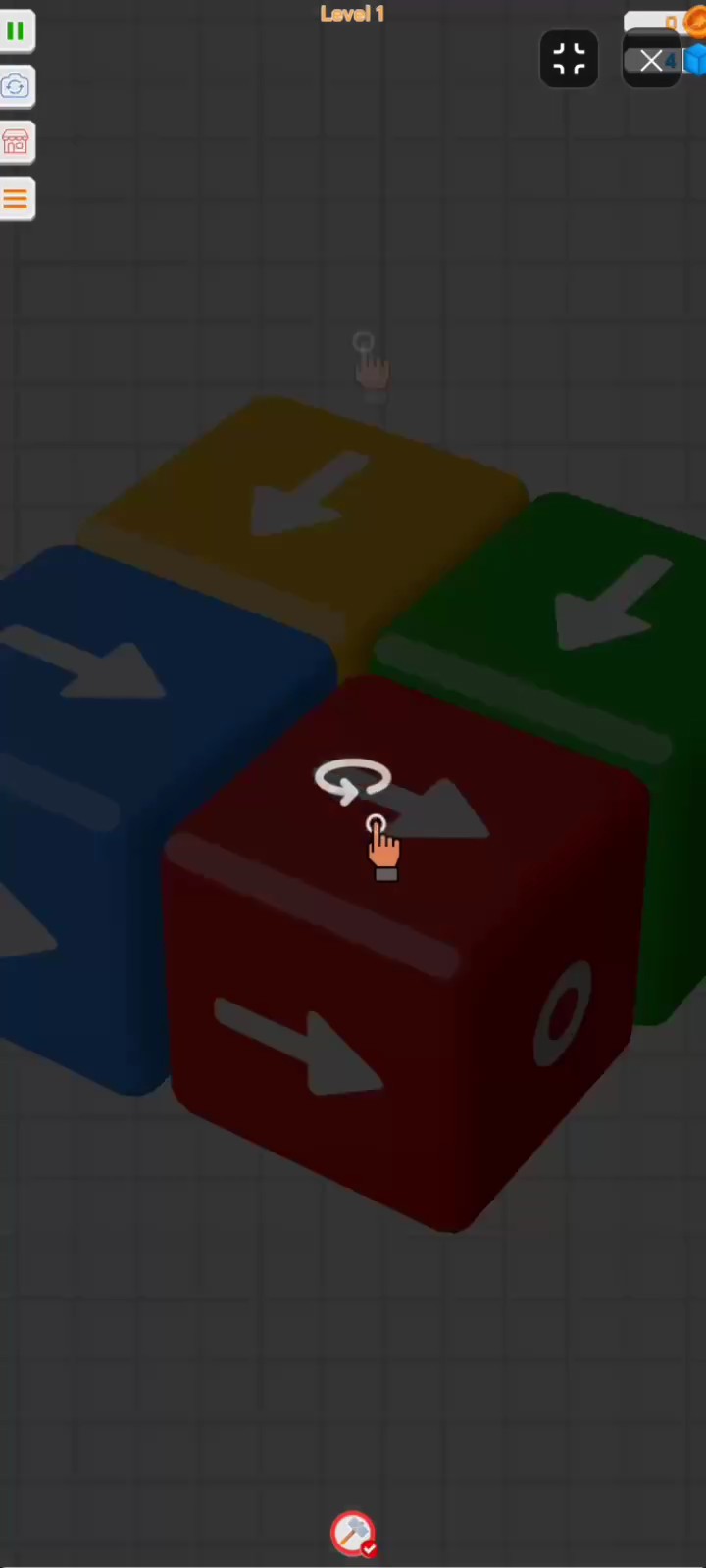
Core Mechanics: Understanding Directional Arrow Trajectories & Obstruction Rules
To consistently excel in Tap Out: Block Escape, you must first master the fundamental physical law governing the entire game world: unobstructed directional clearance. Unlike traditional match-3 or block-stacking titles, blocks in this game do not fall due to gravity nor do they disappear upon contact with matching colors.
Instead, the rules are governed by strict spatial conditions:
- Fixed Escape Vectors: Every individual block features a clearly printed arrow on one or more of its faces. This arrow dictates the exact linear axis along which the block will fly when tapped (Up, Down, Left, Right, Forward, or Backward in 3D space).
- Zero-Tolerance Obstruction Check: A block will only escape if its entire flight path is completely free of other blocks. Even if a neighboring block overlaps by a fraction of a millimeter, it acts as an absolute physical barrier.
- Sequential Unlocking (Order of Operations): Because blocks lock each other in place, success relies entirely on discovering the correct removal sequence. You must identify "unlocked" outer blocks first, tap them to clear space, and systematically dismantle the remaining structural cluster from the outside in.
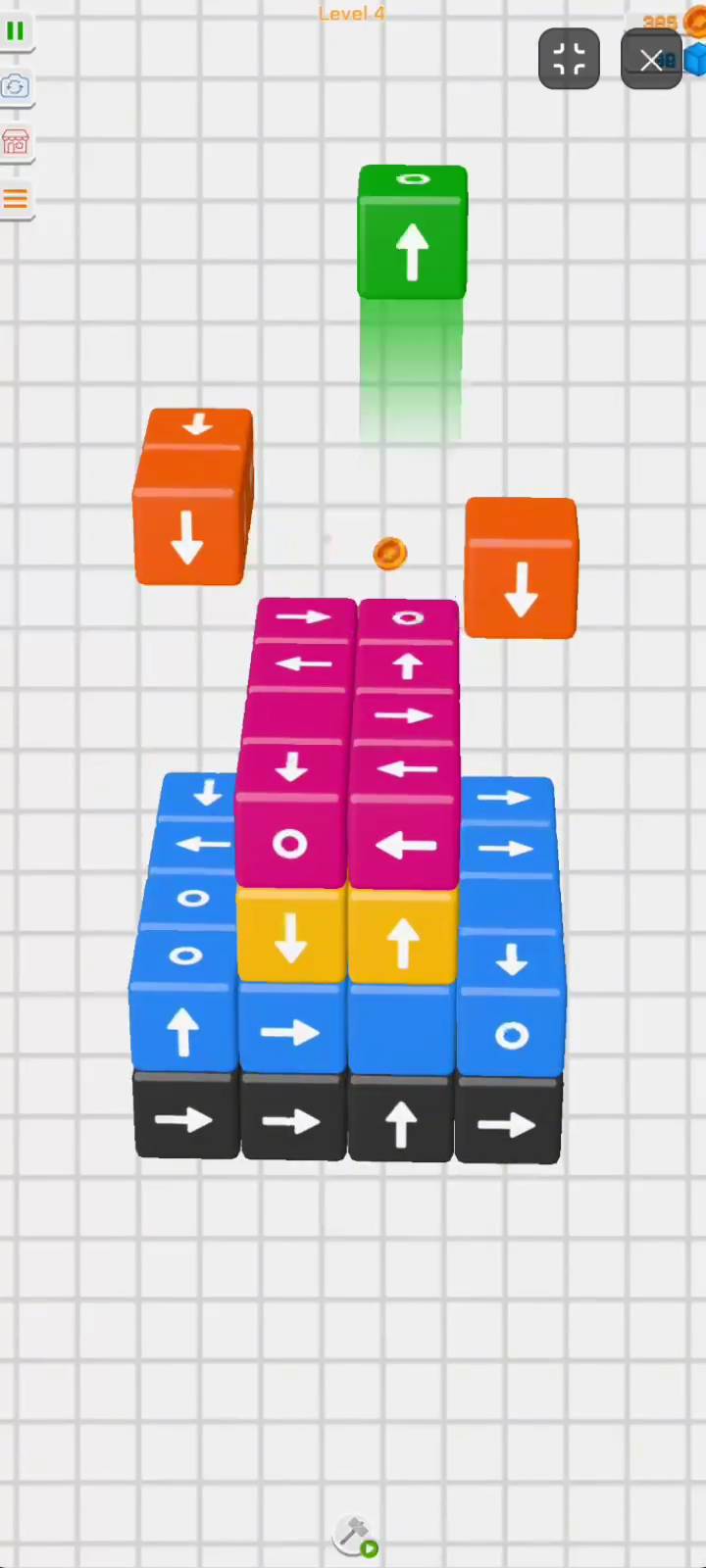
Mastering the 3D Camera: Rotation, Angle Swiping & Detail Zooming
One of the biggest traps for new players in Tap Out: Block Escape is relying on a static viewpoint. Because the game is rendered in a true three-dimensional environment, a single camera perspective creates visual illusions—making blocks appear clear when they are actually blocked, or hiding crucial empty exit corridors behind adjacent geometry.
To overcome visual blind spots, incorporate active camera manipulation into every move:
- Continuous 360-Degree Swiping: Never tap a block based on a single view angle. Gently drag across the screen to rotate the entire block structure, viewing it from the top, bottom, and all four sides. What looks blocked from the front view may reveal a wide-open escape channel when viewed from above.
- Pinch-to-Zoom Detail Inspection: As stages advance, block clusters grow larger and incorporate tight internal hollows. Utilize pinch gestures to zoom directly into the center of dense arrangements. Spotting an interior block with an outward-pointing arrow can unleash a chain reaction that destabilizes the whole structure.
- Aligning Vector Eyesight: Align your camera view directly parallel to the arrow of the block you plan to tap. Looking straight down the sightline of the arrow makes it instantly obvious whether any secondary block cuts across its line of flight.
Gameplay Walkthrough Video: Watch Expert 3D Clearance in Action
Want to see smooth 3D structure rotation, rapid arrow trajectory scanning, and systematic layer dismantling demonstrated in real time? Watch the comprehensive gameplay video below to see master-level block escape tactics applied live:
Advanced Tactics: Identifying "Keystone Blocks" and Avoiding Structural Deadlocks
As you progress into higher level tiers, structures transition from simple geometric cubes into intricate sculptures, letters, and multi-layered mazes. Beating these layouts requires a logical approach to structural breakdown.
1. The Concept of Keystone Blocks
In architecture, a keystone is the piece that holds an arch together. In Tap Out: Block Escape, a "keystone block" is a specific outer block whose arrow points away from the structure, but which sits directly in front of 3, 4, or even 5 other interior blocks. Identifying and clearing this single keystone immediately unlocks a cascading wave of subsequent taps.
2. Working from External Shells to Internal Cores
Resist the temptation to randomly tap blocks deep inside the structure. Always scan the extreme perimeter first. Removing free-floating perimeter pieces gradually thins out the outer shell, giving internal blocks the clearance they need to shoot outward without obstruction.
3. Handling Parallel Lockups
Occasionally, you will encounter two adjacent blocks whose arrows point directly toward each other. This creates a mutual lockup where neither block can move first. To resolve a parallel lock, you must scan surrounding nodes to find a third adjacent block that moves perpendicularly, clearing space alongside one of the locked pair.
Step-by-Step Master Playbook for High-Level Clearance
To maintain high accuracy, eliminate unnecessary taps, and breeze through tricky levels, apply this 5-step systematic method whenever you start a new puzzle:
- Step 1 - Perform an Initial 360-Degree Sweep: Rotate the structure full circle before making your first tap. Note where the structure is densest and where clear openings exist.
- Step 2 - Eliminate Free Perimeter Blocks: Instantly tap all outward-pointing blocks situated on the corners and edges. These are low-hanging fruit that immediately reduce visual clutter.
- Step 3 - Zoom in on Hidden Cavities: Rotate the camera to look straight into hollow centers. Tapping hidden inner blocks early often removes structural roadblocks before you even notice them.
- Step 4 - Trace Flight Paths Prior to Tapping: Before touching a candidate block, mentally trace a line extending infinitely from its arrow. If that imaginary line touches any block surface, skip it for now.
- Step 5 - Execute Cascade Chains: Once a keystone block is removed, immediately follow the flight line backward to tap the newly exposed interior blocks before changing your camera view.
By pairing sharp 3D spatial awareness with patience and systematic rotation, Tap Out: Block Escape transforms from a simple casual distraction into a deeply satisfying mental workout. Spin the puzzle, spot the open vectors, and enjoy the rush of completely clearing the board!
If you have questions regarding spatial puzzle logic, technical performance, or level walkthroughs, feel free to contact our editorial team at support@puzzlechallengehub.com. We are dedicated to delivering top-tier web gaming insights and strategy content.
Play Tap Out: Block Escape Free Online
Tap Out: Block Escape
A relaxing and clever 3D block disassembly puzzle! Rotate intricate cubic structures, analyze arrow flight directions, clear unobstructed blocks, and dismantle complex 3D shape clusters directly in your browser.