Welcome to the ultimate deep-dive into Hexa Color Stack Game. If you've been scrolling through casual gaming catalogs lately, you’ve probably noticed an explosion of "sorting" puzzles. However, this specific title brings a uniquely frustrating—and incredibly rewarding—twist to the genre. We aren’t just sorting liquids in test tubes or matching flat tiles; we are dealing with three-dimensional, multi-layered hexagonal stacks where spatial geometry and forward-planning are your only tickets to victory.
Whether you're struggling to crack level 20 or you're aiming to optimize your moves in the endgame, this comprehensive guide will break down the hidden mechanics, the "Rule of 10," and the optimal moments to deploy your life-saving power-ups. Let’s get stacking.
Phase 1: The Geometry of the Hexagon Board
To succeed, you first need to understand the board's unique rules of engagement. Unlike a standard square grid where pieces only touch on four sides, a hexagonal board means every single tile has six potential points of contact. This is crucial because of how the merging mechanic works.

At the bottom of your screen, the game deals you a "tray" containing three random hexagonal pieces. Your job is to drag and drop these pieces onto the empty slots of the main board. When you place a piece, the game immediately checks all adjacent (touching) tiles. If the top-most color of your placed piece matches the top-most color of an adjacent piece, the tiles will automatically snap together, consolidating into a single, taller stack. This automatic consolidation is your primary weapon for clearing space.
Phase 2: The "Rule of 10" and Layer Peeling
Why do we want these stacks to consolidate? Because of the Rule of 10. Your ultimate goal isn't just to make the board look pretty; it's to eliminate colors entirely.
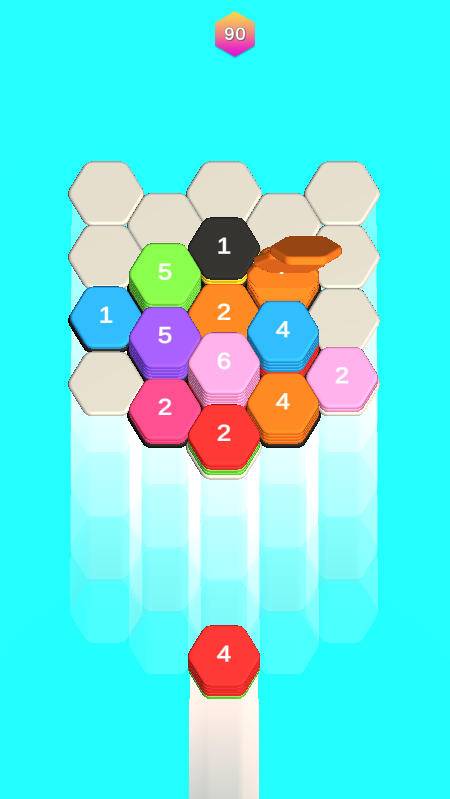
Once a stack accumulates exactly 10 tiles of the same color, that entire color block instantly vaporizes. But here is where the genius of the game design reveals itself: these pieces are often multi-colored stacks. When you vaporize the top layer of 10, you reveal a completely different color hidden underneath. We call this "Layer Peeling."
Amateur players only look at the top color of the 3 pieces in their tray. Professional players look at the second color down. If you place a piece that clears its top green layer, it might instantly reveal a blue layer underneath. If there are already blue tiles next to it, you will trigger an automatic chain reaction! Always plan one layer deep.
Phase 3: Preventing the Dreaded "Board Lock"
The single most common way to lose in Hexa Color Stack Game is achieving a state of "Board Lock." This happens when there are no empty slots left on the hexagonal grid to place any of the 3 pieces currently sitting in your tray.
To avoid this, you must ruthlessly protect your empty spaces. Do not just place a piece in an isolated corner because you don't know what to do with it. Every piece you place must connect to an existing stack to consolidate immediately. If you place a piece that doesn't merge, you have permanently lost a slot on your board until you can magically fix it later.
Video Walkthrough: Chain Reactions in Motion
Reading about layer peeling is one thing, but seeing it execute perfectly is another. Watch this brief gameplay demonstration to see how manipulating the board to trigger 3 or 4 simultaneous consolidations is the true secret to high scores.

Phase 4: Tactical Power-Up Deployment
As you progress into the higher tiers, the game will actively try to force a board lock by giving you colors that don't match anything currently visible. When raw logic fails, you must rely on your arsenal of Power-Ups. Using these at the wrong time is a massive waste of resources.
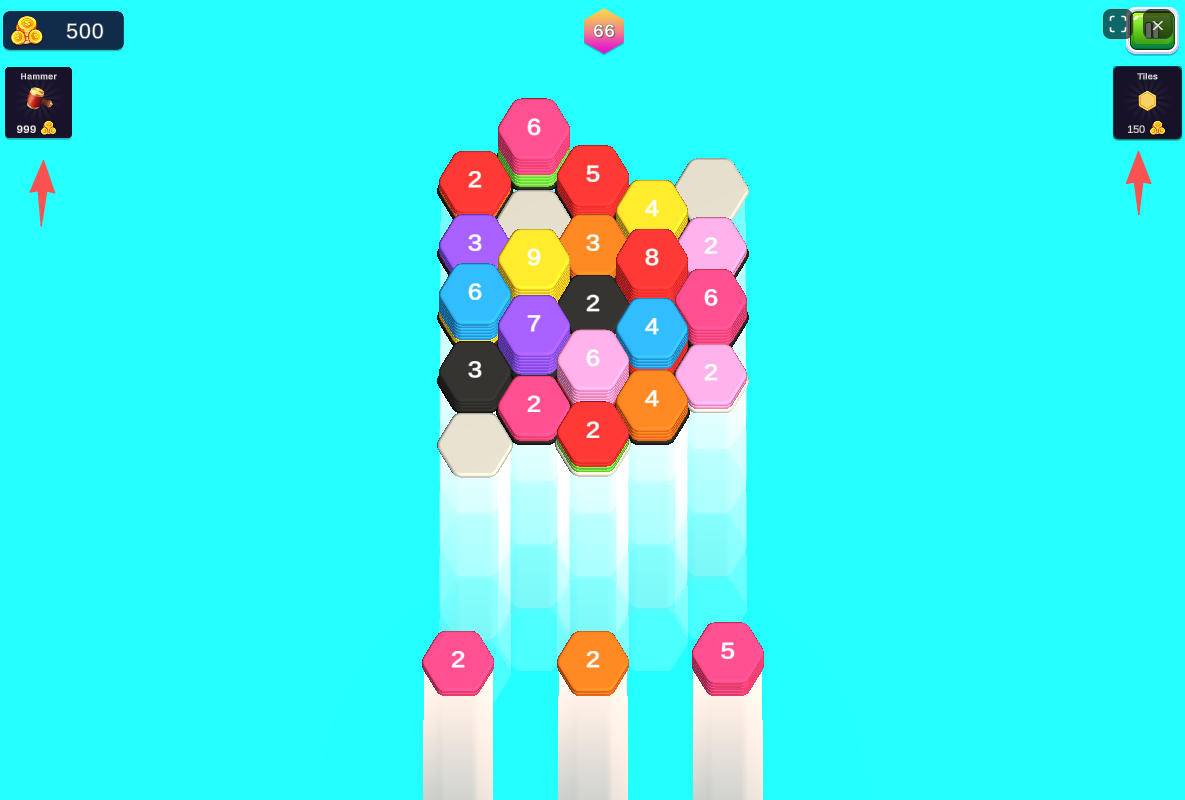
- The Random Remover (Shuffle/Clear): This tool will randomly select one stack on the board and eliminate its top layer, regardless of whether it hit the 10-count threshold. When to use it: Use this when you are one slot away from a board lock and need a quick Hail Mary to reveal a new color underneath.
- The Almighty Hammer: This is your nuclear option. The Hammer allows you to manually select any specific tile on the board and completely obliterate the entire stack—all layers, all colors, gone instantly. When to use it: Save your Hammers! Only use them on "Garbage Stacks"—stacks that have 4 or 5 different colors layered terribly, effectively blocking you from making any meaningful horizontal connections in the center of the board.
Phase 5: Hitting the Targets & Claiming Victory
Every level has a specific objective shown at the top of the screen. You aren't just playing for endless survival; you are hunting specific colors. For example, a level might demand you clear "50 Red" and "50 Blue" tiles.

This means if your tray gives you a choice between placing a green stack or a red stack, and both have valid placement spots, you must prioritize the red stack to meet your quota faster. Once you hit the required numbers, the level ends in a glorious victory screen, rewarding you with coins to buy more power-ups.
Final Thoughts
Hexa Color Stack Game is a brilliant exercise in spatial awareness and queue management. By treating the game like a 3D game of chess—anticipating the hidden layers, guarding your empty board slots fiercely, and saving the Hammer for critical gridlocks—you will find yourself breeze through levels that leave other players completely stumped. Take a deep breath, analyze the tray, and let the satisfying color merges roll in!